
For large agricultural, commercial and industrial buildings, effective rainwater filtration is a critical part of a well-designed rainwater harvesting system. Large roof areas can collect significant quantities of leaves, grit, dust, soil and other debris, making the choice of rainwater harvesting filter particularly important where harvested water is being stored for irrigation, livestock, cleaning or other non-potable applications.
A two-stage rainwater filter provides an effective solution by separating the filtration process into two stages and does so before the water enters the storage tank.
What is a two-stage rainwater filter?
A two-stage, or two-step, pre-filter is designed to remove different sizes of debris during the filtration process. The first stage deals with larger material, such as leaves and roof debris, while the second stage provides finer filtration of smaller particles.
This approach is particularly valuable on larger roof areas. Rather than placing the entire solids load onto a single fine filter surface, the two-stage process progressively removes contaminants before the water reaches the rainwater storage tank.
For designers and installers specifying commercial rainwater harvesting systems, this makes two-stage filtration an important consideration where high volumes of roof runoff and variable levels of debris are expected.
Two-stage filters for large roof areas
3P Technik manufactures a range of two-stage rainwater harvesting filters designed for larger roof catchments. The range includes the VF1, Twin Filter, VF2, VF3, VF4, VF6 and VF12, providing filtration options for roof areas ranging from smaller commercial buildings through to very large agricultural, commercial, educational and industrial roofs.
The larger Volume Filters are designed for substantial catchment areas, with models available for roof areas extending to several thousand square metres. This makes them suitable for applications including farm buildings, agricultural sheds, livestock buildings, farm workshops, barns, warehouses, factories, commercial units and irrigation systems.
For system designers, selecting the correct filter capacity is essential. The filter needs to accommodate the anticipated roof area and rainfall flow rate while providing reliable separation of debris.
Maintenance and self-cleaning
For a large rainwater harvesting system, filtration needs to be effective without creating excessive maintenance requirements. Manually cleaning a small domestic filter is relatively straightforward, but regular intervention becomes considerably less practical when dealing with large agricultural or industrial roof areas.
Two-stage pre-filters help manage the incoming solids load by progressively separating debris during filtration. The 3P cascade filtration principle allows larger debris to be separated at the initial stage before the water reaches the finer filtration stage. Both sizes of debris are directed away from the stored rainwater and instead are directed to waste.
The result is a filtration system designed to handle the higher debris loads associated with large roof catchments while reducing the amount of material entering the storage tank.
As with any rainwater harvesting equipment, filters should still be inspected and maintained in accordance with the manufacturer’s recommendations, with consideration given to the surrounding environment and the amount of debris generated by the roof.
Two-stage filtration and agricultural rainwater harvesting grants
Two-stage filtration is also particularly relevant to UK agricultural projects. The Farming Equipment and Technology Fund (FETF) has specified two-stage pre-filtration for eligible rainwater-harvesting systems over successive funding rounds. The requirement was included in the original FETF Round 1 specification published in 2021, and continued through the subsequent FETF rounds, including 2023 and the later 2024, 2025 and 2026 specifications. The specified system requirement is a two-stage pre-filter for removing debris and soil from water before it enters the storage tank.
For farmers and agricultural businesses considering grant-funded rainwater harvesting for irrigation, specifying an appropriate two-stage pre-filter is therefore a vital part of the system design.
Selecting a two-stage rainwater filter
The correct two-stage rainwater harvesting filter depends on several factors, including:
- Roof or catchment area
- Installation configuration
- Available space
- Connection sizes
- Access for inspection and maintenance
A filter should be sized according to the requirements of the complete rainwater harvesting system rather than simply choosing the largest available model.
3P Technik two-stage pre-filter range
| 3P Filter | Maximum roof area* |
|---|---|
| VF1 | Up to 450 m² |
| Twin Filter | Up to 800 m² |
| VF2 | Up to 1,200 m² |
| VF3 | Up to 1,500 m² |
| VF4 | Up to 2,300 m² |
| VF6 | Up to 3,000 m² |
| VF12 | Up to 5,100 m² |
*Maximum catchment areas depend on the specific installation and design conditions – see below.
Configuring rainwater harvesting filters for a large roof
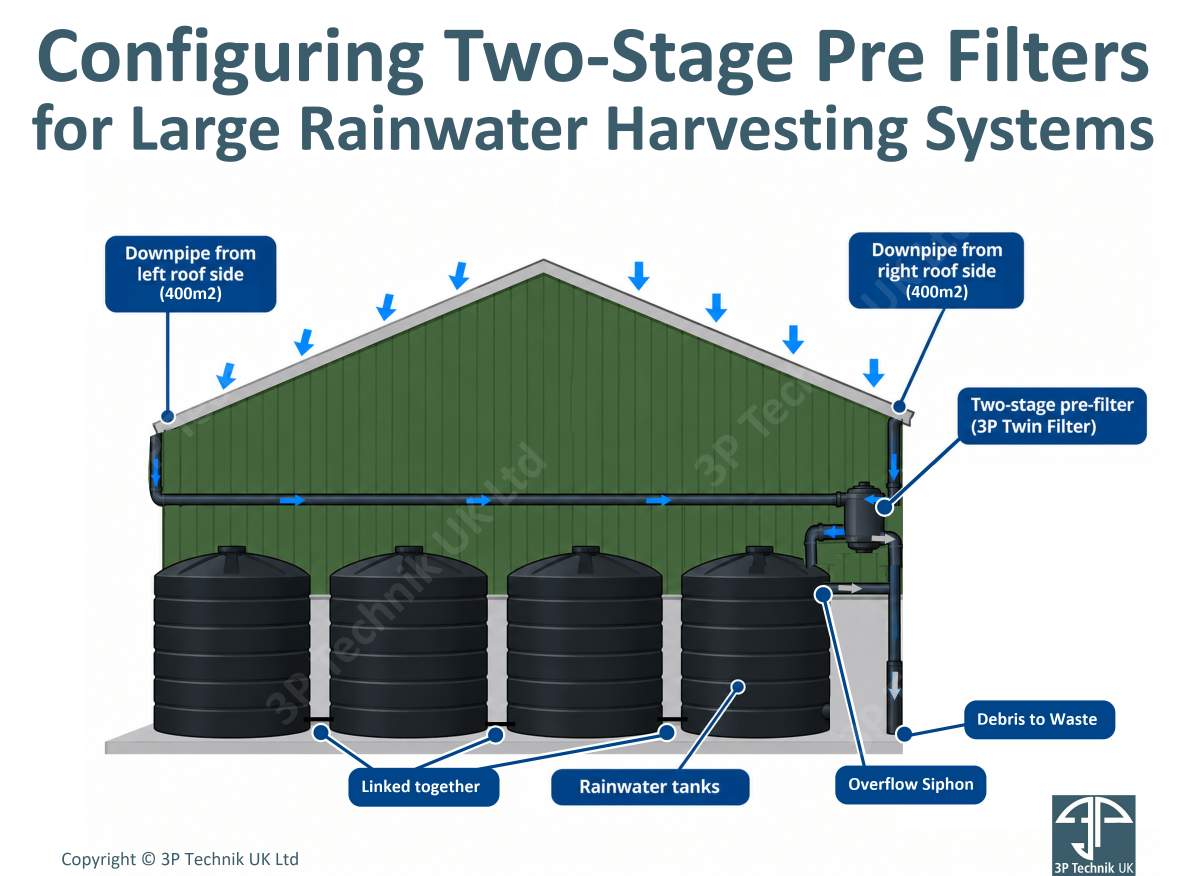
On larger agricultural and commercial buildings, there are several ways to configure the rainwater collection and filtration system. Where practical, multiple downpipes can be brought together on one side of the building and connected to a single appropriately sized two-stage filter, with the filtered water then directed into a large storage tank. Additional tanks can be connected in series, allowing the system to expand its overall storage capacity as required.
Alternatively, a separate filter can be installed on each downpipe. In this arrangement, the total roof catchment is distributed between the individual filters according to the roof layout and drainage design. For example, a building with multiple roof pitches, apexes and downpipes can have each filter sized for the proportion of roof area draining to that particular downpipe. This can be particularly useful where bringing all downpipes together would require extensive pipework or where the building’s existing drainage arrangement makes distributed filtration more practical.
The choice between a centralised or distributed filtration arrangement depends on the roof geometry, number and position of downpipes, hydraulic flow rates, available space and the required storage capacity. In either configuration, each filter should be correctly sized for the catchment area and expected flow entering it, rather than simply dividing the total roof area equally between filters.
For more information
For larger agricultural, commercial and industrial rainwater harvesting systems, a correctly specified two-stage pre-filter provides an important first line of protection for the storage tank and the wider water reuse system. Choosing the filter according to catchment area, hydraulic requirements and expected debris load helps ensure reliable performance from a large-scale rainwater harvesting installation.
At 3P Technik we are always happy to review and discuss rainwater harvesting products and water quality treatment designs. Contact us with your requirements.